
Core
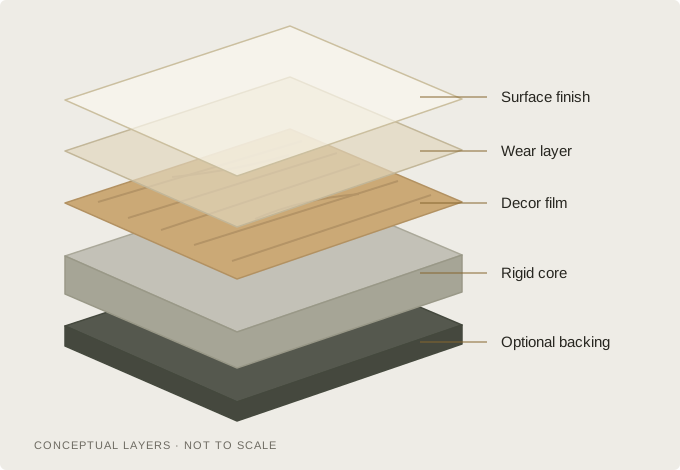
The core is the body of a rigid-core construction. Your quote should identify the material and its thickness basis, rather than using a total-flooring figure as a substitute.
Two floors can carry the same headline thickness and contain different constructions. Your comparison needs separate values for the board or core, wear layer and attached pad. A clear measurement basis helps you compare the quotation with the product you intend to sell or install.
Your supplier's written specification should make the measurement basis clear before the order is approved.
The core is the body of a rigid-core construction. Your quote should identify the material and its thickness basis, rather than using a total-flooring figure as a substitute.
Your overall figure may include attached backing. The specification should say whether it measures the board alone or the complete assembly, so the floor-height comparison uses the right value.
The transparent protective layer over the printed decor has its own thickness. Your chosen value cannot be inferred from the total board or core thickness.
Backing adds a separate material and thickness. Your quotation should name it explicitly; acoustic performance requires evidence for the relevant tested floor assembly.
NIST defines 1 mil as 0.001 inch, equal to 0.0254 mm. For your comparison, 20 mil equals 0.508 mm; commercial rounded labels are not exact conversions.
| Wear layer in mm | Approximate mil equivalent | Comparison note |
|---|---|---|
| 0.3 mm | 11.8 mil | Often rounded to a 12 mil label. |
| 0.5 mm | 19.7 mil | Often described as approximately 20 mil. |
| 0.7 mm | 27.6 mil | Often rounded to a 28 mil label. |
Your final order should state the actual quoted measurement and unit.
These owner-confirmed ranges describe supply options, not application ratings. We confirm the exact combination for your proposed SKU.
| Product family | Published measurement basis | Wear layer or backing |
|---|---|---|
| SPC | 4–8 mm core | 0.3 / 0.5 / 0.7 mm wear layer; optional IXPE/EVA pad 1–1.5 mm. |
| Dry-back LVT | Typically 2–3 mm overall, no pad | 0.2–0.7 mm wear layers across the LVT range; exact combination quoted. |
| Loose-lay LVT | Typically 3.5–5 mm, grip-backing construction | The backing and installation format belong in the product specification. |
Your comparison should use the same configuration and commercial scope.
Your two quotations may differ in wear layer, backing, plank size, finish or fixing method. Separate values expose those differences before you choose a supplier.
Quantity per decor, carton scope, delivery terms and production origin also affect the quoted price. Your supply-only comparison should not use a delivered or installed budget as though it were equivalent.
Your approval should connect appearance with the configuration being priced.
Your team can compare color, texture, gloss and joined edges on the sample. The retained reference establishes the agreed appearance.
Your written specification identifies the board or core, wear layer, backing and fixing method. The quotation should use that same product reference.
Your application may call for emissions, fire, slip or acoustic evidence. We match available reports to the proposed product instead of inferring performance from thickness.
Your current specification, reference product or target price is enough to begin. Technical preferences can remain open for recommendation.
Your destination, preferred appearance, estimated quantity and packaging scope establish the supply discussion.
Your area, installation brief, budget basis and required documents help focus the proposal.
Your current specification, sample reference or target price gives us a starting point. We will confirm the product, quantity basis and proposed supply terms with you.